

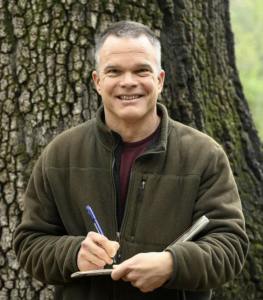
About this episode
We all spend time in nature to some extent, but there is something truly unique about how John Muir Laws approaches his work (yes, that is his given name). Laws is a naturalist, illustrator, and educator whose depictions of the great outdoors bring a fresh perspective to many places and spaces that we all take for granted. A few steps removed from your typical climate warrior, John—who goes by the nickname Jack—works across vast political and socio-cultural divides to bring the joy of nature journaling to audiences around the world. In his journey, which took him from roaming the Sierra Nevadas to sparking an artistic movement, he demonstrates that the best way to succeed in difficult climate discussions is to find common ground with the simple things, like the birds and trees in our own backyards, that connect us. In this episode, Jack takes us through a lesson in nature art that could very well change how you see the world around you—and maybe inspire you to slow down and pay attention a bit more than you would otherwise.
Notes and resources
- John Muir Laws’s website
- Americans’ partisan identities are stronger than race and ethnicity, Stanford scholar finds
Full transcript
Michael Ethan Gold (00:01)
John Muir Laws, welcome to Climate Swings. It’s so great to have you here.
John Muir Laws (00:05)
It’s a delight to be with you as well. Thank you so much.
Michael Ethan Gold (00:09)
So the first thing I just have to get this out of the way, your name, John Muir Laws, I know you go by Jack, but that John Muir Laws is the name that your parents gave you, is that right?
John Muir Laws (00:18)
That’s right. My mom and dad were both avid naturalists. Their whole courtship was romping through the Sierra Nevada together. I think my mom was finally hooked on my dad when he went out into a frozen lake to get one of her, she was a fly fisher woman and her fly got caught on a log and he went out into this frozen lake and kind of secured it. I think they had fish that night and whatever happened
they decided to, that he was the right guy for her. So they bonded in the Sierra Nevada. She was a Sierra Club lawyer. They both were naturalists, but I’m not actually named after John Muir. I would have been middle named Muir, whether I was male or female. And the John came about a little bit later because I’m named after my grandfather. So between a grandfather and a great grandmother.
Michael Ethan Gold (01:06)
Okay.
John Muir Laws (01:16)
who is a Muir. They really liked the way those two things came together.
Michael Ethan Gold (01:21)
But Muir is not a given name for you. That’s actually one of your surnames.
John Muir Laws (01:27)
So, no, no, Muir is my legal middle name given to me by mom and dad.
Michael Ethan Gold (01:33)
I see, but, but it would have been, you said it would have been Muir anyway, so they didn’t choose it because of John Muir. I see. Got it. Got it. Got it. All right. So now that we’ve started with like the very, very basics, which is essentially your name, let’s just start at the beginning of your story. And maybe you can just provide like a very brief kind of self-introduction,
John Muir Laws (01:38)
That’s right.
Michael Ethan Gold (01:53)
for the audience who might not be familiar with you and what you do.
John Muir Laws (01:57)
Well, I am a naturalist. So I originally got interested in birds and then that curiosity expanded to all the rest of the biodiversity on the planet. I’m an educator and I’m an artist. And so a big part of my process is as I go romping around in the natural world, I keep a notebook with me. And in that notebook, I fill it up with sketches and observations of whatever
phenomenon I’m in front of. So I use drawings and, and, and, and writing and counting and measuring to observe. And that trains me to pay more attention to the natural world around me, to get more curious about the world around me. And that has been such a transformative life experience for me that I’ve spent the last
few decades really teaching this approach to other people. So I’m also a nature journal evangelist. I try to help other people pick up a notebook and use it as a tool to forge a deeper relationship with the natural world.
Michael Ethan Gold (03:11)
And so can we talk about some of your early entry points into your worldview? Because you discussed how your parents were avid naturalists and you have John Muir in your name. So I’m curious, how did that interest and those passions start to form for you from an early age?
John Muir Laws (03:34)
That’s a good question. I’m not sure because I’m just a sample size of one. So I don’t have, I can’t run the experiment if I’ve been named Henry Ford or something like that. But if you’re named John Muir, you grow up around those stories. My own grandmother is giving me John Muir books. And so you just read through these little books and you’re thinking like, like what do do when there’s a windstorm? You find the tallest tree and you climb up to the top of it. Of course, that makes perfect sense.
Michael Ethan Gold (03:44)
Mm-hmm.
John Muir Laws (04:03)
So I grew up with those stories and playing in nature was a regular part of our family routines. But going into nature on my own also became a really important way for me to heal. I am dyslexic and I had a lot of struggles in elementary school, in middle school, in high school.
In those situations, you are evaluated on how well you can spell or do multiplication tables fast. And my brain is reversing letters and, just making chowder of things. So by the end of a school day, I was completely beaten down. But between home and the school, ⁓ was Golden Gate Park in San Francisco.
And what I would do is regularly, kept a little notebook in my backpack and on the way home, nobody, nobody told me to do this. it just was a routine that I came up with on my own. would just loop through the park and wander through the trees and go crawling through the bushes, looking for birds. Eventually there was a pair of binoculars added to my, my backpack. And I’d, so I have a little nature adventure with this notebook in my hands
looking for bird nests and what are the squirrels doing? And I was drawing pictures of everything that I saw. By the time I would come out of the park, maybe it was just a half an hour of a detour on the way home. My brain had reset. I was a different person. And I could carry on. Nature and this process of deep observation has been…
part of my routines, part of my life for a long time.
Michael Ethan Gold (06:00)
And at what point or were there certain, I guess, catalytic factors that made you think that this is what you want to do for your career? Because you can’t really study nature journaling in college as a degree, I presume, but how did you sort of incorporate that into your professional life?
John Muir Laws (06:10)
Yeah.
Yeah, there was, I don’t think there was any big.
There wasn’t one big watershed moment. This was always something that I was doing in the background. And then more and more, it started to just show up in my life, in my world. A few kind of maybe more kind of transitional moments. One was when I was an environmental educator in just a little bit north of San Francisco. There was a large
ranch, cattle ranch turned into environmental education center called the Walker Creek Ranch. And I was a naturalist there and every week I would work with a large group of kids. And during my own free time, I would run around and draw the flowers and the deer and, and kept a notebook. And the students saw me doing this and wanted to do it with me. So they asked if they could during their breaks
go nature journaling with me. And so we started doing that. And I realized that this was such a more effective environmental education tool than what I had been doing before. And it was what I liked doing. The kids wanted to do it. So I would then just make journals for everybody. And my program more and more became, let’s go out into nature, pay attention, use this journal as a tool to document what we see. That was one transformative moment.
If I could point to one other, in spite of having these sort of moments of clarity where I think like, my gosh, this journaling is so important to me. I got a job. I got a good job for me. At the start, I was doing a lot of nature journaling with it. I was an environmental educator at the California Academy of Sciences, which is a natural history museum in San Francisco.
Michael Ethan Gold (07:55)
Mm-hmm.
John Muir Laws (08:22)
But here’s the problem. If you do a good job, you get promoted. Are you familiar with the Peter principle? So the Peter principle is if you do something well, you get a promotion and now you’re doing something different, which is probably taking you closer into some administrative network. Exactly. Managing people. So if you’re good at doing one thing, you then become the manager. And if you do…
Michael Ethan Gold (08:27)
Mm-hmm.
Explain it to me.
Right.
or managing people.
John Muir Laws (08:48)
Well at that, then you get promoted again to an even more managerial role. And finally, you end up doing something that you have no facility to do and you’re making more money and you’ve got the prestige, you’re incompetent at it. And that’s where you stay. People sort of usually rise to the level of their incompetence in an organization and then they stay there.
Michael Ethan Gold (09:01)
or even passion for potentially,
Mm-hmm.
Mm-hmm.
John Muir Laws (09:16)
Instead
of kind of going back, you know, I was a lot happier and more effective when I was doing that other thing. So I became a manager and dyslexic me was then sitting behind a computer with clean shoes on and managing budgets. And I was terrible. I was terrible at doing that. And, but just…
Michael Ethan Gold (09:20)
Mm-hmm.
All right.
John Muir Laws (09:44)
It kind of creeps up on you and you’re thinking getting a raise, that’s a good thing. I’ll do that.
Michael Ethan Gold (09:50)
more,
a higher position, better, more prestige, right? Yeah.
John Muir Laws (09:54)
Right. So
I started, yeah, you’re in there, you’ve got more money, you’ve got more prestige so that your brain is thinking, this is what I’m supposed to be doing. But the thing that pulled me out of that was the death of my grandmother. As she was dying, she lived down in Southern California. Family members went down and we spent time with her.
Michael Ethan Gold (10:04)
Mm-hmm.
I see.
John Muir Laws (10:23)
and just were witness. And my role was to sit up with her at night. And there was a, in case she kind of woke up and had a more lucid moment, either needed something or there would be somebody there to talk to. And so most of the time I was sitting alone in the dark and just listening to her breathe and there was a busted digital clock that was making kind of abstract patterns. And…
Michael Ethan Gold (10:50)
Mmm.
John Muir Laws (10:51)
I had a lot of time to think about when I’m in that bed, what do I want my life to be, have been about? Would I be sitting there thinking, you know what I really should have done?
Michael Ethan Gold (11:00)
Mm.
More spreadsheets. More spreadsheets.
John Muir Laws (11:06)
Or would I be going, yeah, that’s right. I’m I’m
so good at Excel, right? And I realized that there were a couple of things. Well, she was sort of my artistic muse, right? She was a watercolorist. And anytime I would do a painting or a drawing of a bird, she would frame it and put it in her kitchen. Her kitchen was filled with all these pictures of birds that I’d done.
Michael Ethan Gold (11:21)
Hmm.
Mm-hmm.
Mm-mm.
John Muir Laws (11:35)
And she, as she was there in the bed next to me, I was thinking, okay, there’s two things that I would like to do. One is, I think I’d like to be a papa and have a family.
Michael Ethan Gold (11:53)
Mm-hmm.
John Muir Laws (11:55)
And the second is, for years I’ve sort of had in the back of my head the design for a field guide to the Sierra Nevada mountains that would be all illustrated. So just beautiful color, watercolor illustrations. And, and I wanted somebody else to make it so my backpack would be lighter. And I realized that, you know what, I keep fantasizing about this field guide.
I need to do that. At some point, I’m not going to be able to do that. And the time really is now before I have a family. And so after she died, I returned to San Francisco and I quit my job. I studied scientific illustration for nine months and then filled a backpack with paper
Michael Ethan Gold (12:30)
Mm-hmm.
Mm-hmm.
John Muir Laws (12:54)
and granola bars and went up into the Sierra Nevada mountains and for the next seven years was bopping around the mountains and wearing holes in hiking boots and painting thousands of illustrations of insects and birds and animal tracks and mammals and reptiles and amphibians and lichen, everything that I could see and formulating that into a field guide.
And so that then got me back out into the natural world. And I was observing and connecting with nature all the time. That was sort of a huge moment in my sort of development as a, as a naturalist. But there was never a point where I said like, this is my career path. I just realized at one point I’m on the wrong one and I’m going to pop over there and everything. Once I, I, I.
Michael Ethan Gold (13:34)
Mm-hmm.
John Muir Laws (13:53)
kind of reoriented, all sorts of things have just blossomed and grown and I’ve made relationships with people and places and it has, so it looks, now as I look back people are like, there was a plan, but there actually never really was a plan, but I sure like the way it happened.
Michael Ethan Gold (14:11)
Yes.
Well, it does sound like that that year, how old were you that year that your grandmother died that you went into the Sierras?
John Muir Laws (14:23)
boy.
So I had.
I had already, I’d finished college. I had worked at the outdoor schools for a while. I had gone to graduate school, come back, and then worked at the Academy of Sciences. I don’t remember exactly how old I was. I guess something like that, yeah.
Michael Ethan Gold (14:51)
Must have been in your late 20s, presumably. Something like that. Yeah.
So, I mean, it sounds like what you were aiming for from a bigger picture perspective was really making nature tangible, making it visual, making it into something that could really connect with people on a gut level. You had started out as an environmental educator already and you were discussing some of the classes you taught and you were working at Cal Academy. How was…
nature being taught, how was environment, what was environmental education like to the extent that you felt there was something missing.
John Muir Laws (15:31)
Well, you can’t go too wrong. Anytime you get kids outdoors, right? That’s the win. If we get kids into natural areas, we’re doing something right. But at that time, the state of the art was playing nature games. And what we would do is there were these books of activities that you could do with kids.
Michael Ethan Gold (15:36)
Mm-hmm.
John Muir Laws (15:59)
You could play how many bears can live in the forest. You can play the thicket game. You can play, Oh, Deer. So there was Project Wild and Project Learning Tree. And Joseph Cornell wrote a great book called Sharing Nature with Children.
Michael Ethan Gold (16:14)
And guess you can
go out and count the number of lichens or something like that. You can do those kinds of…
John Muir Laws (16:19)
But it was,
that would be good. But most of it, you’re, you’re, the way I look at it now is we were playing, we were bringing kids out into natural settings, then playing these nature games. There wasn’t a lot of really deeply observing and looking at nature. And what
Michael Ethan Gold (16:43)
Mmm.
John Muir Laws (16:46)
the journaling brought into focus for me was that a lot of those games, I think, are a distraction. They’re great to play in.
Michael Ethan Gold (16:57)
Mmm.
John Muir Laws (17:02)
You know, sometimes it’s, you know, playing tag is great and you’re, running around and that’s, that’s healthy. That’s fun. I I’m all for tag, but I was fooling myself into thinking that I was teaching about food webs and ecosystem dynamics by saying, okay, you’re the Fox and you’re a bunny rabbit and you’re going to chase you. And then you’re grass and the bunny’s going to chase you and let’s have this tag game. And at the end of the day, the kids are playing tag. And I was thinking that I was teaching about ecosystem dynamics. Okay.
Michael Ethan Gold (17:25)
Mm-hmm.
Right.
John Muir Laws (17:31)
I’m really, love playing tag. That’s great. But I find when I am taking this journaling approach, I am giving kids the tools and adults the tools to pay attention. And if you pay attention, you build relationships with places, with people.
Michael Ethan Gold (17:48)
Mm-hmm.
John Muir Laws (17:59)
Attention is love.
Michael Ethan Gold (18:02)
Mmm.
John Muir Laws (18:03)
And the more, if you think about sort of your relationship with a child, with your partner, with a place that you’ve gotten to know over time, the thing that builds that relationship is attention.
And the journal is a tool for focusing our attention. So if I, if I don’t have the notebook in my hand, I find that I am a much more casual observer and my memory of what I see is not as good. But with that notebook in my hand, I can go so much deeper into the world.
Michael Ethan Gold (18:26)
Mm-hmm. Mm-hmm. Mm-hmm.
Mm-hmm.
Mm-hmm.
I don’t want to be presumptuous, but presumably you’re not the first nature journal evangelist or person to have gone into nature and drawn and sort of tried to reflect deeply. Who were your kind of, I mean, maybe I’m thinking of like Robert Frost or something, who were your sort of titans of the craft and of the practice that you tried to learn from as you were developing your skills?
John Muir Laws (18:57)
This is no joke.
Not at all.
So yeah, I’m starting off with this little notebook in my hands and I.
I could on my own figure out some wonderful things you could do with it. And then I came across a book by Claire Walker Leslie called Nature Drawing, a Tool for Learning. And this rocked my world. It had a combination of really useful practical tools to help you be able to sketch what you see. The other thing it had going for it
Michael Ethan Gold (19:35)
Mm-hmm.
Mm.
John Muir Laws (19:56)
was just this mindset of paying attention to what is this moment, what is happening here, and exploring that through the pages of a journal, finding little mysteries and then geeking out on things. That book, ⁓ was game changing for me. Then,
Michael Ethan Gold (20:12)
Mm-mm. Mm.
John Muir Laws (20:24)
some years later when I was in college, was working summers at the Teton Science School. I got to meet her. She came and taught a class there. And they say never meet your heroes, but in this case, it was even better. Just a gracious, wise, brilliant, brilliant person. She and Hannah Hinchman
Michael Ethan Gold (20:33)
Mm-mm.
Hehehehe
John Muir Laws (20:53)
who was another person who had written some books on nature journaling. They co-taught a class. And after I would finish teaching my stuff there, I would go in and I would just be a fly on the wall and got to go with them on weekends. And that was really, really wonderful. So those two folks were really influential in my practice. And if you look at the way that I journal, a lot of this, can very clearly,
Michael Ethan Gold (20:53)
Mm.
Mm.
Did di-
John Muir Laws (21:21)
trace back to like, ⁓ you have studied from Claire Walker Leslie.
Michael Ethan Gold (21:26)
Did you consider yourself like a visual artist, a visual painter, a visual thinker before this kind of before you sort of brought nature into it? Or was that something you cultivated alongside the nature passion?
John Muir Laws (21:39)
I came at it because I was a little, a young nature nerd. I love geeking out in nature and the, the journal was the tool that I was using and I didn’t really identify myself with the tool. I saw myself as a nature kid who draws. And I think that’s actually, that’s probably pretty fortunate because when I would frame it that way,
Michael Ethan Gold (22:00)
Mm.
John Muir Laws (22:07)
then it’s about the nature. And if I get a pretty picture, great. If I don’t, that’s great. And what that does is it takes the pressure to make a pretty picture. It takes that pressure off of the process of drawing because I’m interested in nature. I recorded some observations about it. Isn’t that thing I found in nature fun?
Michael Ethan Gold (22:29)
Mm-hmm.
John Muir Laws (22:32)
And then that gives me permission just to write the, do the next one and the next one and the next one. And it turns out if you make a lot of drawings, you get better at it.
Michael Ethan Gold (22:32)
Yeah.
you get better.
Right. Yeah.
John Muir Laws (22:41)
And there’s
kind of a fiction that we have about, you know, playing a musical instrument or shooting a basket or whatever it is that there’s some people who are born magically being able to do this stuff. Drawing’s the same way that, you’re so lucky to have that drawing gift. It’s not a gift. Just like all those other things, it’s practice. Focusing on nature gave me permission to put in the pencil miles
Michael Ethan Gold (23:00)
Right.
John Muir Laws (23:10)
to be able to do that.
Michael Ethan Gold (23:12)
Right.
So moving forward from that field guide that you did in the Sierra Nevadas, did you ultimately get that published? I know you’ve published several books since then. So can you talk about your sort of publication history and also just kind of the practice that you’ve built up to this day and kind of your, you know, your sort of education community that you’ve built up, which is quite impressive.
John Muir Laws (23:32)
I did do the book. It was and it was transformative in my relationship to the natural world, just immersed in the natural world for for years and not just immersed in it doing something that required me to be paying deep, deep, deep attention. Deep focused attention. And that really
profoundly shaped who I am. Throughout that process, I also was keeping little notebooks and sketching what I was seeing. I was doing some illustrations for the field guide, but I’d also see, here’s a cool interaction between a pine martin and a chipmunk. I’m going to take my notes about that. So I’d had all these little, didn’t end up well for the chipmunk, by the way.
Michael Ethan Gold (24:04)
Mm-hmm.
You
John Muir Laws (24:31)
I then had all of these notebooks, so I’d had more practice observing and connecting with nature through those notebooks. After doing that, I had been doing so much journaling that I’m thinking like, I’ve got a lot of tricks and techniques that I now have developed, that people have taught me and then I’ve modified, or that I perhaps came up with on my own, although probably all the things I think that I innovated
I got from somebody else. I decided I was teaching classes on then how to do nature journaling. And I thought I’m going to just put a bunch of my notes onto paper so that I can have better handouts. And then I was getting more handouts. And then I thought, just put all these together in a book. So I then wrote a book on how to do nature drawing and journaling and a book on how to draw birds and then book on how do you teach nature journaling that
Michael Ethan Gold (25:03)
Mm-hmm.
Mm-hmm. Mm-hmm.
John Muir Laws (25:31)
This is something that I really want to get out into the world as a tool, as a resource for people, because for me, it’s had an incredible impact on my happiness of being a human being on the planet. It also has made me more passionate about protecting and preserving this natural world, because as you pay attention, you’d build a relationship.
Michael Ethan Gold (25:46)
Mm-hmm.
Mm-hmm.
John Muir Laws (26:02)
And love is sustained, compassionate attention. And that’s what I practice every time I pick up that journal in the presence of nature. If I share that with other people, I think other people also can develop that higher levels of connection with the world around them. And that’s what’s going to motivate us to protect the world that we live in. And also if you are in the work of
Michael Ethan Gold (26:06)
Mm-hmm.
Mm-hmm.
John Muir Laws (26:31)
of working to protect nature, sometimes that work is heartbreaking. And how do we heal ourselves? And I think that coming back into nature with deep attention and focus, the tools allow you both to look out and pay attention to the world
Michael Ethan Gold (26:43)
Mm-hmm.
John Muir Laws (26:57)
around you and also then to give yourself the same love and to look inside, to pay attention there, that experience then put down on the paper is incredibly healing.
Michael Ethan Gold (27:10)
Yeah. Yeah. And the idea of kind of caring about the natural world, protecting it, but also being able to face the heartbreak that maybe comes with it, that kind of backs us into the climate discussion a little bit. But before, but before we get to that, I just kind of want, cause you, you have a very different background than most of my guests who kind of work in the climate industry, so to speak. What’s your day to day like now? I mean, how you wake up and you just teach like, you know, a million students every day. How do you kind of craft your career
John Muir Laws (27:21)
Yeah.
Michael Ethan Gold (27:40)
⁓ right now?
John Muir Laws (27:46)
Every, well, my most important job is I’m a papa and a husband. And so I’ve tried to really show up as a human being with this little crew that’s around me. So it’s usually, you know, starts with snuggling and then making breakfast for everybody, helping the girls with their instruments, this
one of my daughters and I, we play ukulele together and she’s much better than I am. But with practice, I’m getting better. So that’s really fun to see. Then the of the events of the day start to come in. I’m doing a lot of teaching online right now. So I will through the magic of Zoom
Michael Ethan Gold (28:33)
Mm-hmm.
John Muir Laws (28:40)
meet with people all over the world. Every week I’m teaching free workshops for educators and for people who want to do nature journaling themselves. Sometimes those workshops are like, let’s take a look at how do you draw squirrels? What is, what’s the anatomy of the squirrel? How do you get the texture of that tail and all those things kind of coming out? How do you make that look fuzzy?
Michael Ethan Gold (29:05)
Mm-hmm.
John Muir Laws (29:06)
How can you use, how can you describe the behavior of what you see? Other times I’m doing interviews, interviews with people who are doing aspects of nature journaling that are different than what I do, but I think are really, really cool. I just interviewed an amazing poet and it helps me think about how can I include poetry in my own journal?
Michael Ethan Gold (29:25)
Mm-hmm.
John Muir Laws (29:34)
I recently had an interview with some folks who are working to conserve African penguins in South Africa, and they are on the edge of collapse because the place where they go feed is being overfished. And we then, we learned about that in the class. We then made art to educate people about that and then shared them on, on social media. And so as a little kind of artivism
Michael Ethan Gold (29:50)
Mm-hmm.
John Muir Laws (30:04)
event that was that was really really fun. And I’m also teaching classes live. COVID drove me into the into the Zoom space and and I’m still doing a lot of that because that allowed me to connect with people that I otherwise would not be able to but I I love people.
Michael Ethan Gold (30:05)
You
as it did for all of us.
Mm-hmm.
John Muir Laws (30:34)
They’re my species.
Michael Ethan Gold (30:35)
Yeah.
Where do you, you’re based in the Bay Area, so where do you usually teach now? Live.
John Muir Laws (30:41)
So
I recently got back from Texas, taught some nature journaling programs there. Other nature journaling programs, sometimes there are, it’s easiest when I can find something close to the Bay Area, but sometimes I am, I do find myself kind of going to remote locations.
I also do some nature journaling adventures. So this summer I’m going to be heading, romping off to Tuscany to nature journal in Italy. Boy, I’m very excited about it. So sometimes there’s an adventure. Nature journaling has taken me to…
Michael Ethan Gold (31:23)
Wow.
That sounds wonderful.
Yeah.
John Muir Laws (31:40)
You know, Greece and Tanzania, the Galapagos Islands, and you go there with a crew of nature journalers, you get this critical mass of really curious people. And it is so much fun because everybody’s asking questions and, and we’ll find some, some, you know, a cool spider and then the geeking out starts and
it is even more fun and even more contagious when you get that kind of critical mass of joyful, curious people. And then we’re all putting it into our journals. And what’s neat about that is then everybody’s doing it. They’re putting it in their journals in slightly different ways. And then you put all those journals next to each other and you realize, my gosh, that’s a cool way of doing things. I want to try what you’re doing. And so people will start stealing ideas from each other and sharing strategies. Kaboom, your growth
Michael Ethan Gold (32:15)
You
John Muir Laws (32:39)
in this gets gets multiplied because you’re in that kind of group environment.
Michael Ethan Gold (32:44)
And I presume it’s all ages right like from young kids up to adults runs the gamut
John Muir Laws (32:46)
Absolutely.
Yes.
And that’s something that’s also cool about it. When we do these nature journaling field trips, they’re intergenerational. And the youth look at the elders and they go like, ⁓ this is legit. This isn’t just one of those things that grownups tell kids, you should do this. But I’m not going to do it. Like all the parents who are on their phone while telling their kids to read more.
Michael Ethan Gold (32:55)
Mm-hmm.
Right.
Right.
John Muir Laws (33:16)
They’re there
watching, literally watching Netflix. Well, it’s only like, like, I need you to do your reading. No, no, no, don’t read. Yeah. So, so, and so they say like, this is, this is authentic. This is something that you’re really showing up for. Great. All right. And then the elders are looking at the youth and they’re seeing like, ⁓ you’re totally not intimidated by this. I have all these kinds of, I can’t do this. I’m not at this, not at that. And you’re just diving in. Huh.
Michael Ethan Gold (33:19)
Yeah.
Yeah, this is putting your money where your mouth is. Yeah.
Mm-hmm.
John Muir Laws (33:46)
I guess I’m gonna be like you. Right, so, and then, and then we, so here’s a big strategy with these sort of field trips and events, if you make it a potluck lunch, then the whole group just blends together even more and everybody gets to know each other. So it’s also a way of making community, which is another thing we really need right now. We need to come together in real human space, celebrate together so that the fabric of our
Michael Ethan Gold (34:06)
Right.
John Muir Laws (34:17)
our relationships is made in real human space. That I think makes us much healthier, much stronger. It’s so easy if you’re just looking at stuff on the web to one, fall into a bubble and two, to see the people who are outside of your bubble as less than, as something that you cannot interact with.
Michael Ethan Gold (34:18)
Mm-hmm.
Yeah.
Mm-hmm.
Mm-hmm.
John Muir Laws (34:46)
When real human beings are face to face with each other,
it’s much easier to see the humanity in other people.
Michael Ethan Gold (34:54)
Right, right,
yeah. So I definitely will get to the climate connection. But one more thing before we do that, because I really want to take advantage of the visual aspect of your work, so could you do like a two minute, just like quick, how to sketch a something, how to sketch a bird maybe? I’ll follow along on my iPad and stylus. I know you have a…
John Muir Laws (35:13)
Sure, yeah.
Michael Ethan Gold (35:17)
a special camera that can show the viewers what your hands are doing. And I’ll be talking through it, or we can sort of talk through it, for the audio listeners, if that’s all right.
John Muir Laws (35:19)
Yeah.
Yes, absolutely. And I’m just looking out my window now and I’ve got some water in a pan that I put out for the birds and there are birds at the feeder. So I’ve actually got some birds. So let’s take look at that. I see, ⁓ there’s a little junco out there. Let’s take a look at this junco. And what I’m going to do is I’m going to demonstrate how I use the journal.
Michael Ethan Gold (35:40)
That’s wonderful.
Okay.
Mm-hmm.
John Muir Laws (35:57)
Not
for the goal of making a pretty picture. It may end up being a pretty picture or not, and either way is good. But I will probably learn something or I may get curious about something. So something that you’re gonna see me doing is intentionally trying to be curious. And I try to actively get curious. Like how can I get my brain to kind of, I’m looking for those little kind of moments where your brain goes, huh, hmm.
Michael Ethan Gold (36:09)
Mm-hmm.
Mm-hmm. Mm-hmm.
Mm-hmm.
John Muir Laws (36:27)
those little
hmmms. I’m going to try to find some of those and really lean into it. Let me change my camera here to…
Michael Ethan Gold (36:32)
Okay.
Yeah.
So we can follow, so for the podcast audio listeners, Jack is going to change his camera so that it’s a sort of a downward facing camera.
Michael Ethan Gold (36:50)
All right, so we are now, ooh, I think you were sharpening your pencil there, is that right? Yeah, I can hear that. All right, so really hands on here. So everyone who is listening to this, we are now watching Jack illustrate a bird. So Jack, take it away.
John Muir Laws (36:56)
Yeah, so I’m just gonna sharpen a couple of pencils here and then… There we go. All right.
So the tools are really simple. I’ve just got a couple of colored pencils. These are not anything special. These are Crayola pencils that my daughters weren’t using. So I’m looking out and here’s the setup. There’s a little bird feeder and it is hanging.
Michael Ethan Gold (37:19)
Mm-hmm.
Mm-hmm.
John Muir Laws (37:36)
It’s it’s it’s hanging above the ground and there’s some birds popping around on the ground. There’s some birds up on the feeder and there are
Michael Ethan Gold (37:42)
Mm-hmm.
John Muir Laws (37:49)
The ones that are up on the feeder are old house finches.
Michael Ethan Gold (37:54)
Mm-hmm.
John Muir Laws (37:56)
And the ones that are on the ground, there’s some house finches down there and there’s also a bunch of juncos. There’s no juncos up on this little feeder. So one thing I’m initially wondering is, is the…
Michael Ethan Gold (38:06)
Mm-hmm.
John Muir Laws (38:15)
Is this just by chance that at this moment there are no juncos up there? Or is it that the juncos prefer to pop around on the ground? So I’m making a little sketch that shows this little bird feeder and making some little squiggles down towards the bottom that will just be my little birds. And…
Michael Ethan Gold (38:22)
Mm-hmm.
Right.
I’m trying to follow along by sketching what you’re sketching too, even though I can’t see it myself just to see how it goes.
John Muir Laws (38:47)
So cut yourself some slack because it’s a lot easier to draw from.
Michael Ethan Gold (38:50)
I know.
actual real life.
John Muir Laws (38:57)
Yeah,
they’re actual real life things. So if you’re saying like, like, how’d you do that? It’s because the real bird is in front of me.
Michael Ethan Gold (39:05)
Right, right, right.
John Muir Laws (39:07)
So, but these little squiggles down towards the bottom that I have here, those, they look a little bit like juncos, but what I’m going to do is I’m going to add a little line pointing down to them, and I’m going to say three juncos.
Michael Ethan Gold (39:16)
Mm-hmm.
Mmm.
Mm-hmm.
John Muir Laws (39:27)
and one, ⁓ house finch.
Michael Ethan Gold (39:33)
Mm-hmm.
John Muir Laws (39:34)
And I’m going to draw a little line pointing to the ones on the feeder, and I’m going to write three house finch. And this raises the question for me. So now I’m going to write in on the page. So I’m going to do the show and tell things. I’ve got no juncos.
Michael Ethan Gold (39:44)
Mm-hmm.
Mm-hmm.
John Muir Laws (40:00)
on feeder.
Do they prefer?
feeding on the ground.
Michael Ethan Gold (40:13)
Mmm.
John Muir Laws (40:19)
And so what this does is this, ooh, they all just flew off.
Michael Ethan Gold (40:24)
All the birds or just the juncos.
John Muir Laws (40:25)
All the birds.
So I’m now looking around, is there a hawk that has come in? Oh, no, they’re coming back.
Michael Ethan Gold (40:28)
⁓ is there a hawk.
Interesting. Okay,
maybe a false alarm. Gotcha.
John Muir Laws (40:37)
Yep, false alarm.
So I’m now going to, so what I’ve done here is I’ve made an observation and then I’m looking at what is the kind of, is there a question that I can find from that? And because of that, now what I’m watching as these birds come back, do the house finches return down here? I mean, to the feeder, do the juncos keep, the juncos are coming back in on the ground?
Michael Ethan Gold (40:43)
Mm-hmm.
Mmm.
John Muir Laws (41:06)
That
is interesting. So this is a small sample size. It’s still possible that this is just all sampling error. But I’m going to take a little closer look at some of those juncos. So I’m making a light little sketch of this bird. I often will start a drawing with kind of a light
Michael Ethan Gold (41:12)
Yeah.
Right.
Mm-hmm.
John Muir Laws (41:35)
I’m
scribbly doodle. And that is a place that I can.
Michael Ethan Gold (41:37)
Mmm.
John Muir Laws (41:45)
It’s easy for me to change my light scribbly doodle. And I can kind of get the angles and proportions to be a little bit better with it. And then…
Michael Ethan Gold (41:48)
Right.
John Muir Laws (42:00)
As the drawing starts to kind of build up from there, I can go over that with say another color or a darker pencil. If you’re here, what I’ve done is I started my drawing with a sort of a light red colored pencil. And now I’m going over that with a dark blue colored pencil, the whole and
Michael Ethan Gold (42:10)
Yeah. Yeah.
Yeah.
Yeah.
Mm-hmm.
John Muir Laws (42:28)
but that those initial scribbles
with the red pencil really kind of helped me block in that shape.
Michael Ethan Gold (42:38)
Yeah. And it was so interesting because I felt like what was happening is you were really describing a process and asking a question too, is why were the juncos on the ground? Why were the house finches in the feeder? And then a little bit of drama with the hawk that never was. So I can see that it’s helping you and helping the drawer to really connect
John Muir Laws (43:00)
huh.
Michael Ethan Gold (43:05)
much more deeply than you would even if you were just watching it intently without drawing it. You’re sort looking at what’s the cause and effect and lots of factors like that.
John Muir Laws (43:12)
Okay.
Yep. So that’s, that’s, that’s absolutely right. So I’m the, the taking the notes keeps me looking back and the intentional curiosity then pulls. All right. So now I’m kind of, still watching and here’s, here’s, here’s the update. So all flew off. ⁓ when they came back, ⁓
Michael Ethan Gold (43:36)
Mmm.
Mm-hmm.
John Muir Laws (43:51)
Dark-eyed juncos.
Still.
only on ground.
Michael Ethan Gold (44:02)
Yeah, yeah, yeah. And again, for everyone listening, I would really recommend you go check out the YouTube because it’s amazing to watch this process unfold and you’re really getting a sense of what Jack is actually looking at here. And also his process for nature journaling, which is amazing.
John Muir Laws (44:21)
I’m going to write in, this is my backyard.
Michael Ethan Gold (44:24)
Yeah.
John Muir Laws (44:26)
in San Mateo.
Michael Ethan Gold (44:30)
Yeah, great.
John Muir Laws (44:32)
And then today is the 26th. So I’m going write Feb 26, 2025. So this is date stamped and geo-referenced this. It is a completely sunny day, no clouds. I’m drawing a little sun up there in the corner. And so all of,
Michael Ethan Gold (44:35)
Yeah, of February 2025.
Amazing.
amazing.
You
Right.
John Muir Laws (45:01)
these by date stamping and geo referencing what I’ve got. I helped to turn the, the journal page that would just be, it’s a picture of a junco into a really useful scientific observation.
Michael Ethan Gold (45:06)
Mm-hmm.
Yeah, yeah, yeah, you’re contributing
to the kind of collective body of knowledge about the world, basically.
John Muir Laws (45:25)
And it’s still just a small sample size all in one place. But how interesting. Juncos only on the ground. So I’m going to do one last thing here. And that is what I call sort of metacognition. So really thinking about what I’m thinking. The
Michael Ethan Gold (45:28)
Right.
Yeah. Yeah.
Okay.
Mm-hmm.
John Muir Laws (45:50)
I’m going to look at this page and think to myself, what is for me the most interesting question or observation? And for me, the big thing here is this, I’m going to kind of go for this question of do they prefer feeding on the ground? And, and then I’m going to see if I can go deeper with this idea. So the first thing I’m going to do is I’m going to draw a big block
Michael Ethan Gold (45:59)
Hmm… Mm-hmm.
Mmm.
John Muir Laws (46:20)
question mark next to this just to kind of celebrate that a cool idea has happened here. And then, then this, so what am I going to do for follow up? I am going to number one, I’m going to make myself a little box here to check off when I do it. I’m going to write, look for,
Michael Ethan Gold (46:23)
Mm-hmm.
Mm-hmm. Mm-hmm.
John Muir Laws (46:47)
dark-eyed junco.
Michael Ethan Gold (46:50)
Mm-hmm.
John Muir Laws (46:52)
on feeders.
Michael Ethan Gold (46:53)
Okay. Your next art project has already come to you essentially.
John Muir Laws (46:59)
Yeah. So this is then priming me to kind of geek out and look, to look for, for, for more of this. and, and, and who, who’s, who’s up and who’s down. So this, this whole kind of mystery is not something that I thought like, I’m going to pretend to come up with this question. This is really just sort of what happened as I was looking out the window here. And I think it is, it’s an authentically
Michael Ethan Gold (47:08)
Yeah.
John Muir Laws (47:29)
interesting idea. And so that happened just in real time right here. And so I can look for that. And then what else? I can say, who else?
Michael Ethan Gold (47:30)
It’s incredible. Yeah.
That’s amazing.
John Muir Laws (47:49)
is ground
Michael Ethan Gold (47:52)
ground feeding. Yes, interesting. Wow.
John Muir Laws (47:53)
versus feeder, right?
And can I, so what I’m doing is I’m trying to intentionally take this little nugget that was interesting and squeeze it and see what drips out. So I’m trying to, what else kind of occurs to me? Like as I’m thinking about this,
Michael Ethan Gold (48:07)
Mm-hmm.
Yeah.
John Muir Laws (48:22)
them on the ground. So then like why? Why is that? There’s more food up there. So I’m going to go why? Why? Now whenever I come up with a why question, so I’m kind of mind mapping this actually on the paper as we go. The best thing to do when you have a why question is you can start to come up with different possible answers.
Michael Ethan Gold (48:26)
You
Right.
Yeah.
Yeah.
Mm-hmm.
John Muir Laws (48:52)
But you want to avoid the danger of just settling for the first possible explanation that comes to you. So I’m gonna go why and here is, is it safer?
Michael Ethan Gold (49:07)
Mm-hmm. Mm-hmm. Mm-hmm.
Mm-hmm.
John Muir Laws (49:14)
Have the other ones kicked out somewhat more food that maybe there’s just more food?
Michael Ethan Gold (49:19)
Mm-hmm. Mm-hmm. Yeah.
John Muir Laws (49:23)
And maybe it is that they’re too close, personal space.
Michael Ethan Gold (49:33)
Something about the feeder itself, perhaps. The design of the feeder doesn’t work for the beaks or the bills of the juncos.
Yeah.
Wow.
John Muir Laws (49:48)
So
could you design a different feeder that would have the juncos coming to it? This is one of these sort of hanging things and you sit on a little bar and then you can feed out of a little tray. So why isn’t that working for you?
Michael Ethan Gold (49:57)
Yeah.
Wow, yeah.
It’s amazing how many different directions that can take you in. Sort of nature has these infinite different possibilities that you can explore. That’s incredible. That’s incredible.
John Muir Laws (50:14)
That’s and so it’s
not so much about the drawing itself, but about this process of paying attention, being curious, and leaning in. If I didn’t have this page in front of me, it would have been difficult for my brain to do all of this. Our human brain can handle about seven different ideas at a time plus or minus two.
Michael Ethan Gold (50:19)
Yeah.
Yeah.
Yeah, absolutely.
Yeah.
Mm-hmm. Mm-hmm. Mm-hmm.
John Muir Laws (50:45)
The piece
of paper can handle much more complexity. So on this page, I’ve got the posture of the juncos, the patterns on its body, the spacing of the ones that are on the ground, the shape of the bird feeder. I’ve got this mind map of all these questions, two boxes of things to look out for.
Michael Ethan Gold (50:49)
Right.
Mm-hmm.
Mm-hmm.
Yeah, several potential
reasons why. it’s incredible.
John Muir Laws (51:15)
Yeah. And
so the process of doing it just here, so it’s a little gift from you to me because you said, go do this. I had an opportunity to do this. And in this, this little magical moment has emerged a mystery that I have never really wondered about before is now dancing in my head. And that wouldn’t have happened if you had not suggested
Michael Ethan Gold (51:28)
Mm-hmm.
Yeah.
John Muir Laws (51:45)
that let’s just get out and journal for a moment. And what is neat about that is that that kind of opportunity is available everywhere to anybody.
Michael Ethan Gold (51:50)
Wow, wow, yeah.
to anybody, yeah.
Okay, I’m gonna turn off this recording now and we’ll switch back the camera and then we can ask some final questions about the climate connection, okay? Okay, one second.
John Muir Laws (52:11)
Absolutely.
Michael Ethan Gold (52:15)
Well, that was fascinating. I was sort of trying to follow along on my little iPad with a stylus, but I kind of gave up after a while because I wasn’t seeing what you were seeing and I understand sort of the need for the immediacy of it. So.
John Muir Laws (52:27)
Yeah.
And that’s actually part of the point is that this process is about the juncos out there. It’s about what is happening there. It is not actually about what is happening on my page. The page is a tool in service of observations of the junco.
Michael Ethan Gold (52:30)
Yeah.
Yeah.
Yeah.
Right, right, right.
Absolutely. Yeah. So this is definitely the longest I’ve gone for a podcast without truly diving into climate, which is fascinating and fabulous because I just, think your, your skills and your interest in your passions, what you do is so, is so, it’s so wonderful. But I guess the first question that I have about the climate connection is really how do you, do you bring climate into your work and into your education? Is it something that you talk about? Is it something that you try to educate about? And, ⁓
John Muir Laws (52:57)
Yeah.
Michael Ethan Gold (53:19)
how do you do that to such different audiences? Because some people care a lot, some people may not, right?
John Muir Laws (53:25)
Yeah, and it’s even more interesting than that, as I’m sure you’ve discussed with other people. Climate has become politicized. And because with anything that gets politicized, our ability to think rationally about it tanks, because there’s some interesting studies that have been done looking at
Michael Ethan Gold (53:34)
Mm-hmm.
Mm-hmm.
John Muir Laws (53:56)
the degree to which our political identity…
Where does that fall in terms of how important is your culture? Is your culture more important to you than your political identity? Well, what about your race or what about your religion? Looking at culture, race, religion and political identity, and which ones
Michael Ethan Gold (54:12)
Mm-hmm.
John Muir Laws (54:32)
motivate us and connect with us. In this one study, was actually, looking at this this this morning. It was looking at four different countries, United States being one of them. And of all those factors
Michael Ethan Gold (54:45)
Mm-hmm.
John Muir Laws (54:50)
your political identity is overwhelmingly the strong influencer in your sense of who you are and who you will trust.
Michael Ethan Gold (54:57)
Hmm.
John Muir Laws (55:01)
And so it shows that the big out group
is somebody who has different political feelings to you. And when we do that, what we tend to do is we tend to shut off listening to or learning or being open to ideas from somebody else. We do not trust people who are in that other group. It’s the big other is somebody who’s got a politically different meaning. Now, then what happens is,
Michael Ethan Gold (55:28)
Mm-hmm.
John Muir Laws (55:38)
so any topic then gets politicized, one party saying one thing, the other party saying the other. The minute like, what do you think about climate? People say, what do you think about weather? And then, ⁓ now I know where you stand. You’re on the other team. I now can completely discount everything you say.
Michael Ethan Gold (55:48)
Mm-hmm.
Yeah.
Mm-hmm. Mm-hmm. Mm-hmm.
John Muir Laws (56:06)
I can find reasons to distrust you and we can’t work.
Michael Ethan Gold (56:15)
Yeah.
Yeah. It’s like you ask one person what they think about climate and they’ll say, well, we need to transition to renewable energy. We need to get rid of fossil fuels. We need to drive EVs. And you ask another person, what do you think about climate? And they’ll say, well, it’s a nice day today. The weather’s good. Right? Yeah.
John Muir Laws (56:29)
Yeah.
Or this sort of new line that I’ve seen kind of coming in that is that they’ll start talking about how important to life carbon is.
Michael Ethan Gold (56:47)
Right, yeah. Which is completely antithetical, of course, to dealing with climate change.
John Muir Laws (56:55)
Yeah, it is, yes, we’re carbon-based life forms, but that’s not the point of what we’re talking about.
Michael Ethan Gold (57:03)
Right. I mean,
guess just from a, if you could summarize it sort of crudely, like what proportion of the people that you teach and you work with have, you know, perhaps kind of not quite sound views when it comes to climate, you know? And do you avoid talking about it? Is it, you just kind of feel nature as the common thread? I mean, how do you address audiences like that?
John Muir Laws (57:29)
So I’m going to out myself. I am a left leaning person who finds strong evidence for…
for climate change and that having an anthropogenic cause, right? Right, so that’s where I sit.
Michael Ethan Gold (57:49)
Yep, right, as I presume most of the audience would be too.
John Muir Laws (58:00)
The work that I do allows me to interact and to bridge two communities that otherwise would not be in the conversation.
Michael Ethan Gold (58:14)
Mm-hmm.
John Muir Laws (58:17)
In order to make an impact, I don’t hide and pretend that I have different political views than I do. I do not not talk about it. But I think that establishing a relationship and trust for a long-term conversation
Michael Ethan Gold (58:29)
Mm-hmm.
John Muir Laws (58:46)
is my way of getting in.
Michael Ethan Gold (58:55)
And so do you have any specific instances of times where you were addressing an audience that may not have been in complete alignment with you about climate change or climate science and kind of how did you deal with that?
John Muir Laws (59:10)
So in public presentations and lectures that I do, it is something that I talk about.
I think we need to talk about it. We need to have conversations about it.
Michael Ethan Gold (59:21)
Mm-hmm.
Mm-hmm.
John Muir Laws (59:27)
And by conversations, I don’t mean debates. I think debates are public shows. And the purpose of a debate is to make the other person look bad and to win.
Michael Ethan Gold (59:30)
Mm-hmm.
Mm-hmm.
John Muir Laws (59:38)
And usually in a debate, everybody, are both sort of sitting like that on opposite sides. And you’re kind of going like, I hope my team wins. hope my team wins. And if somebody like tears you apart in a debate, you don’t go away from that thinking to yourself like, gosh, I really need to reconsider this. You go like, okay, next time I’m going to have even more army mission because you said this and I’m going to come back with a zinger for that. And it just, we get more entrenched. So debates are.
It’s performance. And I think it’s a performance that divides us. What connects us are conversations. And particularly, I think long form conversations where you are going to be in a relationship with somebody over a longer period of time. And you can begin to have these
Michael Ethan Gold (1:00:09)
Mm-hmm. Mm-hmm. Mm-hmm.
Mm-hmm.
John Muir Laws (1:00:37)
conversations and that’s got to start with trust. We don’t trust people who are from a political
ideology that is different than ours. So again, what the research is showing that your political alignment is your primary identity in the United States and three other countries that were looked at in this study. And you don’t trust people who are outside of that. They are dangerous.
Michael Ethan Gold (1:01:13)
Mm-hmm. Mm-hmm.
John Muir Laws (1:01:17)
So how do we engage with this? Because just within those parties, there’s a bubble there. So how do you try to pop these bubbles? That is long-term relationships. Which means that I need to get comfortable having long-term relationships with people that I disagree with. And right now, what we’re seeing is lots of people all over the place unfriending
Michael Ethan Gold (1:01:33)
Mm-hmm. Mm-hmm.
Mm-hmm.
John Muir Laws (1:01:47)
even family members that are different political persuasions. We kind of get off of our social media, all the people who have different ideas than we do. And then we get kind of sort of reinforce our bubble. And then there’s this algorithm working in the background going like, oh, you click on that, here’s some more of it, right? And so we’re just sort of spiraling away from each other. And so one…
Michael Ethan Gold (1:01:49)
Mm-hmm.
Mm-hmm.
Mm-hmm, mm-hmm.
Mm-hmm.
John Muir Laws (1:02:18)
kind of sort of side note on that, like really with the social media, just stop. No, stop. It is, it is unhealthy. It is a place for us to get ourselves more angry, more wound up and dehumanize other people. It is, it was an experiment and I think it has failed. It is neat to sort of the idea, original idea of
Michael Ethan Gold (1:02:26)
Hmm.
Mm-hmm.
Mm-hmm.
John Muir Laws (1:02:47)
kind being able to see, granny to see your photographs, that’s great. But it has become, it’s turned into something totally different. And right now I think it is really harmful for our cognition and our hearts and our understanding of reality. I think it is really dangerous right now, but that’s a whole sidecar. I think long form conversations with people that you trust. And so,
Michael Ethan Gold (1:03:07)
Yeah.
It’s in the paint maybe.
Mm-hmm.
John Muir Laws (1:03:17)
what I try to do is to build long-term relationships with people. And because I offer something useful, I can show you some cool tricks about drawing juncos. I think that people are willing to put up with me for longer than they might because I actually am bringing something and sharing something that is useful for them, for their kids.
Michael Ethan Gold (1:03:43)
Right, right. And that’s sort of what I was just thinking is essentially because even if you don’t agree on all the nuances or even if there’s this big point about climate change that you don’t necessarily agree about, the sort of the through line of nature, appreciation of nature, respect for nature, willingness and interest in becoming closer to nature, that is something that you can connect about and form that relationship about, right?
John Muir Laws (1:04:07)
So
we connect with that and then because they’re like, you’re going to get your next class on this. And then we start to develop a long-term relationship. And in that structure of a long-term relationship where there is mutual respect and mutual trust, people start to see like, you’re not
Michael Ethan Gold (1:04:22)
Mm-hmm. Mm-hmm.
John Muir Laws (1:04:36)
evil. You’re not an idiot. You’re not misinformed. You’re brainwashed. You’re just somebody who I disagree with. But I also like your sense of humor and okay, we can hang, I guess. And then and we’re then
Michael Ethan Gold (1:04:42)
brainwashed or anything,
Mm-hmm. Mm-hmm.
Mm-hmm.
John Muir Laws (1:04:59)
I think it is through that kind of a relationship that we can start to through a conversation that we can start to change. Then people say, all right, so then when I am talking to people and I don’t think that from a lectern is the best way to do this, but in one-on-one conversations with people for initially my approach is to be really curious. Tell me more about that.
Michael Ethan Gold (1:05:23)
Mm-hmm.
John Muir Laws (1:05:29)
Tell me more about that. What do see that makes you say that? That’s really interesting. And to be really curious about
Michael Ethan Gold (1:05:32)
Mm. Mm-hmm.
John Muir Laws (1:05:41)
how somebody is seeing things. What are the reasons for that? But what are the real reasons for that? Like, so if that were to change, right, if you were to find out that that wasn’t true, would that actually change your mind? And if people like you and trust you, I think we move closer to a place where we can be willing to change our minds in the presence of evidence.
Michael Ethan Gold (1:06:10)
And some people have almost a religious sort of communion with nature. I mean, there’s a big tradition in many religions about connecting with nature and getting closer to nature. Do you talk to religious communities and?
John Muir Laws (1:06:25)
Very much so.
Michael Ethan Gold (1:06:26)
Do you kind of, how do you find that the messages say about climate resonate with them or is there no kind of like pattern that you’ve seen and it kind of depends on the group?
John Muir Laws (1:06:39)
⁓
I would say that, yes, so for many people, there is a very powerful tradition of nature connection as part of their spiritual practice. And you see this in, even in people who don’t have a religion,
but John Muir talked about that nature is the grandest temple or cathedral.
Michael Ethan Gold (1:07:17)
Mm-hmm.
John Muir Laws (1:07:23)
People of faith
are all over the map on what they think is going on with climate. And it again has more to do with their political affiliation. Just jumping back to the study, I can send it to you. We’ll put a link in the show notes. But what it basically shows is that
Michael Ethan Gold (1:07:38)
Mm-hmm.
Mm-hmm.
Yeah, we can put a link in the show notes.
John Muir Laws (1:07:57)
your political leaning is much more important than religious beliefs in establishing your identity in the four major countries that people looked at. So you will, if there are people of faith and they are blue, they’ll think one way.
Michael Ethan Gold (1:08:13)
Mm-hmm.
John Muir Laws (1:08:27)
If they are red, they will think another way. And it’s so you see both of those, but certainly in many religious traditions, there are very powerful practices of going to nature for inspiration, going to nature for connection with God.
Michael Ethan Gold (1:08:36)
Mm-hmm.
Mm hmm. And in your practice of communing with nature and observing nature and documenting nature, I mean, you’re seeing you’re seeing nature change kind of both due to climate change, also due to a number of other forces and factors. What is your view about sort of the grand sweep of things? I mean, do you do you feel optimistic about
you know, the world given all the challenges that that nature is is facing? I presume you kind of have to being in this line of work, right?
John Muir Laws (1:09:30)
I am optimistic. think that sort of, generally speaking, taking an optimistic approach makes me happier. So practically, it’s useful to be an optimist. But here’s the reasons for it. I…
Michael Ethan Gold (1:09:42)
Mm-hmm. Mm-hmm.
John Muir Laws (1:09:55)
as I have kind of taken this approach of trying to kind of be in deeper relationships with people who I disagree with,
I keep finding people who on, have differences of opinions about things, but when I get to know them, there’s a real human being there. Initially, when I’m of looking from my partisan perch, they’re a cartoon character, but you kind of get in there and they’re a human being, a beautiful, beautiful human being who I happen to disagree with about some things. I think that moral
Michael Ethan Gold (1:10:28)
Mm-hmm.
John Muir Laws (1:10:36)
foundations theory is really useful in kind of helping us understand differences. I think it’s Jonathan Haidt did these very interesting studies looking at what are the characteristics of people that make them either more left leaning or right leaning and found that there are some
big ideas that depending on how strongly somebody kind of holds those big ideas, it’s an incredibly good predictor of whether they’ll be right leaning or left leaning. And each of these are ideas that you can kind of look at them on their own and kind of see like, oh yeah, I could see why that would be a good thing. And then you sort of take, you take each of these characteristics and you kind of put them on a slider and you can weight them differently. So for instance, one is
Michael Ethan Gold (1:11:21)
Hmm.
John Muir Laws (1:11:36)
care and harm. You know, how important is it to care for others and other things versus doing harm? Another kind of example of one of the sliders is how important to you is the idea of sanctity and purity versus degradation. Right? And or what about fairness versus cheating?
Michael Ethan Gold (1:11:55)
Hmm.
Hmm.
John Muir Laws (1:12:05)
What about loyalty versus subversion? We think about these different things and very predictably, people who are liberal score really high on the care and the fairness and all the other sliders are low.
and people who are conservative are high on all of them.
Michael Ethan Gold (1:12:36)
Hmm.
John Muir Laws (1:12:38)
And when I look at it that way, I can go like, there are these kind of underground sort of fundamental values. And I can see why those are really useful and important
Michael Ethan Gold (1:12:42)
you
John Muir Laws (1:12:55)
and we don’t and and my sliders are set in different places.
And that mindset helps me see the value in people who I would disagree with. ⁓ they started with five of these, again, moral foundations theory. They started with five characteristics and they recently brought in a sixth one that ends up being really, really useful for predicting if somebody’s a libertarian or not
Michael Ethan Gold (1:13:20)
Mm-hmm.
you
Mm-hmm. Mm-hmm.
John Muir Laws (1:13:38)
and that is the liberty oppression slider. How important is liberty versus oppression? Like where does that kind of kick in? I think it is useful to frame things this way to help us see the humanity in each other. And so as I look out across people, I am seeing people who are blue and people who are red who are
Michael Ethan Gold (1:13:40)
Hmm.
Mm-hmm.
John Muir Laws (1:14:07)
absolutely beautiful, strong, good people. And there are people who I really disagree with who are good people and have every right to be who they are.
Michael Ethan Gold (1:14:12)
Mm-hmm.
Mm-hmm. Mm-hmm. Mm-hmm.
John Muir Laws (1:14:25)
The danger is when we kind of get a identity that tells us you’re bad and I’m good. So my solution to this is more finding ways to come together.
Michael Ethan Gold (1:14:41)
And looking back over the scope of your career and the work you’ve done and sort of the messages that you’ve tried to impart and the values that you’ve tried to embody, is there kind of anything that you might have done differently or sort of something that you would just want to tell your younger self about getting into this line of work, given that it, you know, in some ways it can be polarizing, in other ways it can be very unifying?
John Muir Laws (1:15:10)
⁓
There’s one big idea that has helped me, has helped me kind of navigate things a lot. And as I’ve gotten older, this has become more and more kind of core to how I approach people, how I approach
issues and how I approach relationships. And that is, when in doubt, be kind.
I think I would stress that to the younger self. I remember at some point a friend helping me kind of with relationship stuff that like, let’s sit down and come up with a checklist of all the things that are important. We go putting all these things on the list. Like, what do you need? Like now I would have one thing on my list and everything else is actually negotiable for me. And the…
Michael Ethan Gold (1:16:04)
Mm-hmm.
Right. Be kind.
John Muir Laws (1:16:18)
I think that that as it started, oh, I’m gonna, I just said there’s one thing, but I’m gonna throw another thing in. And the thing I think is really useful is humility.
Is to realize that I’m currently wrong about a bunch of stuff. And when I die, I will probably have some very different opinions than I have right now. And that’s okay. And that when I meet somebody and we’ve got different opinions about things, they’re not a threat. They are a bodhisattva. They’re an opportunity
to get more insight into something. And so if I kind of approach them with curiosity, like really wanting to understand, maybe this is one of the places that will have the opportunity to change my mind. But I keep kind of coming back to the idea of like, what is the evidence? So the evidence for something is…
I think is really useful, a really useful point in weighing a claim. Kind of coming back to that. But people who disagree with me are opportunities to change my mind in the presence of evidence. And so I’m actively looking for those. I’m looking for opportunities to be kind. And I also realized that with this idea of humility, that doesn’t mean
Michael Ethan Gold (1:17:37)
Mm-hmm. Mm-hmm.
John Muir Laws (1:17:52)
that I can’t act.
Michael Ethan Gold (1:17:57)
You
John Muir Laws (1:17:57)
So
knowing that I don’t have all the cards on the table in front of me, knowing that I may be wrong about stuff, I still have to act in the presence of that uncertainty. And if evidence is strong enough, realizing that my mind may change in the future, but currently the evidence is strong enough,
to deserve action.
Michael Ethan Gold (1:18:31)
And as one final question, if you could cast your mind to the end of your career, and I know that that’s not coming up anytime soon, what would you kind of want your epitaph to be? How would you want people to have remembered your contribution to climate, to nature, to conservation, to the things you care about?
John Muir Laws (1:18:43)
Maybe.
I get to write an epitaph. That’s a fun, that’s a doozy of a last question. Let me try a few on and see how that feels.
I guess one might be, you know.
You know?
It’s okay. You’re still here. Go pay attention to the world and be kind. You’ve used the… Just as my grandmother dying helped me go up into the mountains, realize that you person reading the epitaph still are alive and you have these opportunities to make an impact, to be good
in this world to do something that makes a difference. Make the most of that. I think that death can be very useful in motivating to people to start living a life as fully as they can. Be fun to have something on your tombstone that might sort of motivate people to reflect on that.
Um, cause me down there in the ground, I guess I’m, I’m fine. One of my favorite parts of, uh, Dickens Christmas Carol is the, he’s just been visited by Jacob Marley and Jacob, uh, Marley, his old partner, um, has, has died. It’s his ghost and he was a, a sort of a greedy, clutching person throughout his life. And he’s there giving, uh, Scrooge an opportunity to change
Michael Ethan Gold (1:20:33)
Hahaha
John Muir Laws (1:21:00)
the direction of his life path. And as Jacob Marley kind of leaves Scrooge, when he backs up and kind of floats out through a window that opens as he goes in, and Scrooge hears all this wailing out in the street, he goes out and he looks out into the street, and there are ghosts everywhere of all these people who have died. And some of them are people that he recognizes.
And as people who are like, you know, also kind of just these business people who were kind of wrapped up in that, but they, all these ghosts are distressed by the fact that, ⁓
in their life, they had not kind of gone out into the world to make it better and to be kind and to be good to people. And now they have lost that ability forever. So one is by a poor girl sitting in a doorway who’s hungry, who’s cold, and the ghost cannot help. Right now we have this opportunity to make a difference. And what
Michael Ethan Gold (1:21:52)
Mm.
Hmm.
John Muir Laws (1:22:12)
a beautiful opportunity that is. So I think that that idea of death reminds us that right now I have the opportunity to make a change for the better, to make this world better. I would want to have something on my stone that is reminding people of that. Maybe just tell them to go read Christmas Carol, or at least that.
Michael Ethan Gold (1:22:39)
That’ll, that’ll do it. Wow. That just sent chills down my spine. What a poignant way to end this conversation. John Muir Laws, thank you so much for appearing on Climate Swings. I really appreciate this conversation, your insights and your time today.
John Muir Laws (1:22:53)
Thank you so much and thank you for the work that you are doing. And I want to send a shout out to the people in this community hitting this at all sorts of different levels. We need people who are in policy. We need people in activism. We need people in long form conversations, which people are, or where you are kind of developing a long-term relationship with somebody and building from there. We need people leveraging in…
in Congress, we need people engaging with the media, we need people debunking. All these things that you are doing are important. And as a large community, we are working together towards that. I am so thankful to you for the work that you are doing and want to send you peace and strength. I want to encourage you to go out into nature, to heal yourself and to remind you of why we are in this fight.
In order to be effective, we need to be in this for the long run, for the long term. And so that we don’t burn out. I think going nature journaling is a really, really wonderful way to do it. You want to learn how to do it, come on over to my website. And I’ve got tons of free resources there on how to get started, how to do it, how to connect with other people. And I hope that that can be a real resource for people who are involved in the work of
Michael Ethan Gold (1:23:58)
Absolutely.
John Muir Laws (1:24:21)
protecting our climate and so we can do again, all be into this for the long term. Thank you. Thank you.
Michael Ethan Gold (1:24:31)
Thank you,
thank you.